


You've fitted the kitchen, stepped back to admire your work and spotted it. One cupboard door is sitting slightly higher than the next. The gap between two doors is uneven, or a door that looked perfectly straight earlier suddenly seems crooked.
Naturally, you reach for a screwdriver and start adjusting the hinges.
But what if the hinges aren't the problem?
When kitchen cupboard doors aren't lining up, the cause can sometimes be the cabinet itself. A unit that's out of level, slightly twisted or incorrectly fixed against an uneven wall can make perfectly good doors look misaligned.
Before you spend another half-hour adjusting hinges, it's worth checking what's happening behind them.
1. Start with the obvious: check the hinges
Most modern kitchen cupboard doors use concealed, adjustable hinges. These generally allow you to move the door up or down, from side to side and closer to or further away from the cabinet.
If one door is sitting slightly low or the gap between two doors isn't quite right, a small hinge adjustment may be all that's needed.
Check that:
- The hinge screws and mounting plates are secure.
- The door hasn't dropped under its own weight.
- The hinges are correctly fitted and undamaged.
- The adjustment hasn't already reached its limit.
Always follow the hinge manufacturer's instructions, as adjustment mechanisms vary.
But if you've adjusted the same door repeatedly and it still won't line up, it's time to look beyond the hinges.
2. Check whether the kitchen cabinets are level and square
Even correctly fitted hinges can struggle to compensate for a cabinet that's twisted or out of square. Getting the cabinet properly positioned is the foundation for achieving consistent door alignment.
Imagine fitting a perfectly rectangular door to a frame that's slightly twisted. You might adjust the hinges enough to improve one corner, only to find the gap is now wrong somewhere else.
Kitchen base units need to be installed level, plumb and square. If the cabinet is leaning, the adjustable feet aren't set correctly or the carcass has been pulled out of shape, the doors can appear crooked even when the hinges are functioning normally.
Use a spirit level to check the cabinet across the front and from front to back. Check the vertical sides too.
If you're still installing the kitchen, check the squareness of the units before securing them permanently and making the final door adjustments.
The important thing is to correct the cabinet's position rather than trying to disguise a fitting problem by endlessly adjusting the doors.
3. Don't assume the wall behind the cabinet is straight
Here's something every experienced kitchen fitter knows: walls are rarely as straight as they look.
Older properties can have bowed walls, uneven plaster and corners that aren't quite square. Even relatively new houses can present a few surprises.
Kitchen cabinets, however, are manufactured to be straight and square.
The challenge comes when you're trying to fix those accurately positioned units back to a wall that isn't.
If a cabinet is pulled tightly towards an uneven wall without properly accommodating the gap, the fixing can place unwanted stress on the unit. Depending on its construction, this may contribute to the cabinet moving or twisting out of alignment.
And once the cabinet is out of square, getting its doors to sit perfectly may become a frustrating exercise.
4. What happens behind the kitchen unit matters
Many UK kitchen base units are manufactured with a gap behind them, known as a service void.
This space accommodates pipework, electrical services and other obstacles that would otherwise prevent the cabinets from sitting in their intended position.
It's an important part of the installation, but it also creates a challenge: how do you secure the cabinet to the wall without compromising its position?
Traditionally, installers have used L brackets, battens or packing pieces to accommodate the space behind kitchen units.
These methods can work, but the fixing needs to suit the actual gap and the cabinet construction.
If the fixing arrangement pulls the cabinet away from its correctly aligned position, the result can affect more than the wall connection. It may also affect the finished alignment of the kitchen.
For a closer look at why this gap exists, read our guide to kitchen unit service voids.
5. Fix the cabinet in position, not the position to the wall
This is where choosing the right cabinet fixing method makes a difference.
Ideally, once a kitchen base unit has been properly levelled and aligned with the surrounding cabinets, it should be possible to secure it without unnecessarily disturbing that position.
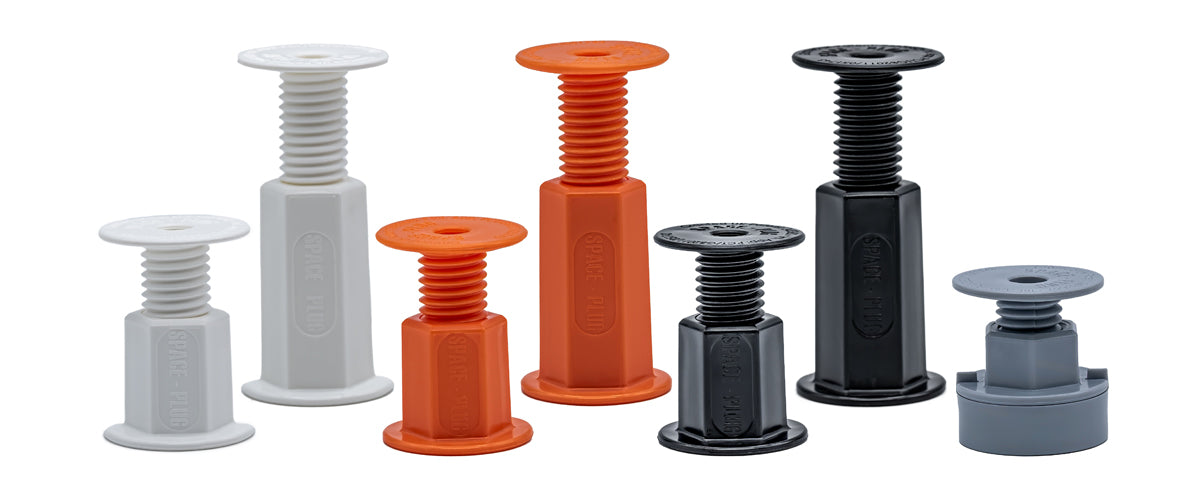
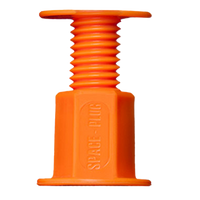
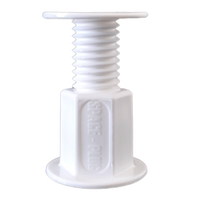
Space-Plug Adjustable Spacer Fixings were designed to help installers do exactly that.
Rather than relying on a fixed-length spacer, Space-Plug can be adjusted to bridge the gap between a suitable structural fixing point on the cabinet and the wall.
The fixing can accommodate different gap sizes, helping the installer maintain the intended cabinet position while securing the unit.
It doesn't replace the need to level the kitchen correctly, and it certainly isn't a substitute for proper hinge adjustment. But where a gap behind a suitable floor-standing cabinet needs to be bridged, it provides a practical alternative to traditional L brackets.
You can explore the different methods in our Kitchen Cabinet Brackets Guide, or see how Space-Plug Adjustable Spacer Fixings work.
The fixing screw must pass through a suitable structural part of the cabinet, such as an appropriate solid back or crossbrace, then through Space-Plug into a suitable wall fixing. Always use screws and wall fixings appropriate for the wall construction.
Space-Plug is designed for securing suitable floor-standing cabinets and furniture, not supporting wall-hung units.
6. Get the cabinets right before making the final door adjustments
If you're fitting a new kitchen, the order of the work matters.
Make sure the base units are correctly positioned, levelled, joined and secured in accordance with the kitchen manufacturer's instructions before making the final adjustments to the doors.
Once everything is stable, small hinge adjustments should be enough to achieve consistent gaps and a neat finish.
If you're dealing with an existing kitchen, start with the simple checks. A loose hinge or mounting plate is far more straightforward to correct than a poorly positioned cabinet.
However, if several doors remain misaligned or the units appear to have moved, the underlying cabinet installation deserves attention. Have a kitchen fitter assess any suspected fixing or structural problem before attempting to alter the installation.
The bottom line
When kitchen cupboard doors won't line up, the hinges are a sensible place to start, but they aren't the only thing worth checking.
Sometimes the problem begins with uneven floors, cabinets that aren't square or the way the units have been secured to the wall.
A properly aligned kitchen starts with properly installed cabinets. Get that foundation right and the finishing touches become much easier.
Fitting a kitchen? Make sure you've got the right fixings for the job.
Explore Space-Plug Adjustable Spacer Fixings and discover a simpler way to bridge the gap behind your kitchen base units.